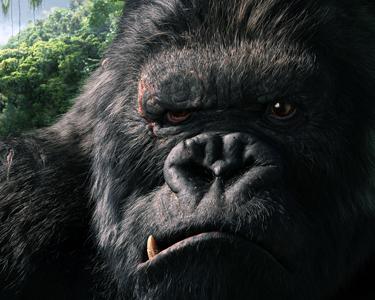
 Learning from Kong
Ever since seeing Peter Jackson’s movie King Kong, I have been reflecting on the ways some human beings seem to be turning into beasts. For those who have seen King Kong (and I highly recommend it), think of the director depicted in the movie. Here was a man who, when faced with scenes of exquisite beauty, was numb to the beauty and wonder all around him since all he could think of was capturing scenes on film for his own utilitarian ends. In not being able to feel any sense of wonder, the movie director had actually turned into a savage, a beast, like the natives on the island. But then, on the other hand, contrast that with Kong - an actual beast - who becomes humanized through the sense of wonder that Ann awakens in him. One of the most moving scenes is where Kong watches the sunset, awakened to sensations that many human beings have become inured to. In a very real sense, Kong was more human than many of people. It brings to mind George MacDonald’s tale The Princess and Curdie, where everyone is depicted as being on a journey of either ceasing to be, or gradually become, a beast.
.
The sense of wonder is a more important aspect of our humanity than many may at first realize. A sense of wonder can contribute to the fear of God. The Lord has saturated our world with emblems of His majesty, to orient us towards that sense of wonder that leads to a fear of Him. The sense of wonder that we feel in the presence of anything truly awe-inspiring, orients the cadences of our minds towards our Creator, even without our realizing it. This is why parents can cultivate the fear of God in their children by putting before the children art, music, literature that is awe-inspiring and wonder-filled. By cultivating a sense of awe and wonder towards the things a child can see and hear, the child can learn to reverence God whom they cannot see and hear.
.
One of the main factors in removing this sense of wonder has been the growth of technology over the past hundred years. Throughout the ages, writers and thinkers have unsuccessfully tried to remove the fear of God – ‘religious superstition’ as they called it - from the mind of the common man. In the end, their agenda was achieved not because the common man was persuaded to give up the fear of God, but because the mind is unable to feel fear of anything – except perhaps electrical failure - when it is submerged us in a sea of tantalizing triviality and terminal trendiness. And this is exactly what inventions such as the telegraph, radio, television and internet and computer games have gradually achieved. These inventions, which had so much potential for good, have largely been used to flood the masses with the waters of endless irrelevancies. The chief casualty in this process has been that the sense of wonder that is vital in distinguishing man from the beasts.
.
In a culture that revolves around the rhythms of nature, there are constant reminders of our own finiteness, just as there are continual echoes of transcendence. In a world saturated with technology, however, it is sometimes difficult to see anything other than the glory of man. In a culture that revolves around technology, there are constant opportunities for that sense of transcendence to be neutralised.
.
This does not mean that technology is bad. On the contrary, technology is a blessing and part of what it means to fulfil the dominion mandate. Technology can certainly be used to point us heaven-ward. However, when most of our technology is designed to be functional rather than beautiful, we have to be aware that the overall effect can be to mute God’s glory. If we are not careful, our machines can draw us into their own world, where everything is mechanical and where we lose the sense of wonder at God’s ways and His world.
Controlled by Pleasure
As with technology, entertainment is a good thing which can be twisted into something bad. I don’t think anyone would dispute that our society has made an idol out of entertainment, but my interest is in the way entertainment-saturation can de-sensitize a culture to God’s glory.
The difference between being entertained and playing is that with the former the person is passive whereas with the latter the person is involved. And as we know from the example of the ancient Romans, entire populations can be rendered passive if the entertainment is sufficiently stimulating. Masses of people can be lulled into passivity by the endless potential for amusement. One of the reasons for this is because an entertainment-centred society breeds an unconscious worldview which says that everything is benign.
In Nazi Germany and the Soviet Union people were controlled by those who could inflict pain; in our culture people would are controlled by those who inflict pleasure. The implicit subtext to 95% of advertisements (perhaps more) is that you should buy whichever products give the most enjoyment.
The advertising industry also plays on our sense of boredom, inviting us to feel bored unless we have the product. Real life becomes dull by comparison. Goodness and beauty also become boring in a culture that is preoccupied with excitement, because they are not stimulating enough. People want pleasures that come easily, and which do not require effort to attain.
The internet, like entertainment, can also breed boredom and disengagement with real life – creating an addiction to external stimulation that can be enjoyed without any inner resources. Good literature, good music and good poetry, which require the cultivation of inner resources in order to enjoy, become boring by comparison.
Boredom
.
Young people these days often complain about being bored. In Patricia Meyer Spacks’ book Boredom: a literary history of a state of mind, she shows that the word ‘boredom’ really only started to be used in the 18th century. Prior to that the equivalent words were all ones which also conveyed idea of sin, such as sloth or aecidia. Medieval writers saw sloth as the most deadly of the seven deadly sins, the closest to hell because it indicated a spiritual and intellectual lethargy – an indifference to the beauty of the world and the glory of God. If you were bored it meant you were bored with God and goodness. William May, in his catalogue of sins referred to sloth as the shadow of death.
According to the medieval writers, it was very serious to have insufficient engagement with life’s obligations and possibilities. They also used the word “Aecidia” to refer to the same state of mind. Aecidia” literally means “absence of care.” Dorothy Sayers defines Aecidia this way: “It is the sin that believes in nothing, cares for nothing, seeks to know nothing, interferes with nothing, enjoys nothing, hates nothing, finds purpose in nothing, lives for nothing and remains alive because there is nothing for which it will die.”
One can have a deep sense of boredom and purposelessness of life beneath a bustle of activity. “To be guilty of aecidia it is not necessary to be physically sluggish at all. You can be as busy as a bee. You can fill your days with activity bustling from meeting to meeting, sitting on committees, running from one party to another in a perfect whirlwind of movement. But if, meanwhile, your feelings and sensibilities are withering, if your relationships with people near you are becoming more and more superficial, if you are losing touch even with yourself, it is aecidia which has claimed you for its own.” (Robertson Davis, “On the Deadliest of Sins”)
Pascal said “The soul course of man’s unhappiness is that he does not know how to stay quietly in his room.” People sense the danger of being alone with their own thoughts, lest they become deeply dissatisfied with themselves and with life, because they have no bigger picture to make sense of their inner world and experience.
The World is Wonderful
It is revealing that the term ‘wonder’ has been largely reduced to an approximation for curiosity, while it’s adjective ‘wonderful’ has been reduced to meaning simply ‘great.’ But if we want to get back to the original meaning of these terms, we need to observe little children. All children are born with this sense of wonder embedded in them. You just have to look into a baby’s eyes to see that sense of wonder. As the baby grows older, that sense of wonder is transferred to every object in his or her environment. But this ‘wonder’ is not mere curiosity; everything the baby sees, and especially everything it manages to get its hands on, is wonderful in the sense of being literally filled with wonder. Things that we would normally think of as being mundane, whether it be wooden spoons to saucepan lids, a baby will find simply magical.
But just as the sense of wonder transforms the mundane into something magical, conversely, without it, even the magical becomes mundane. And that is exactly what happens when the child’s original sense of wonder is stamped out rather than nurtured. Just as the sense of wonder is nurtured by saturating the mind in anything that is truly noble, beautiful and awe-inspiring (beginning with Nursery rhymes and ending with Oratorios), so it is stamped out by letting our children feed the infinite appetite for distractions bequeathed to us by our technological devices. It is stamped out by letting our children go to schools where they learn to despise what is noble and good. It is stamped out by letting television cultivate an enjoyment for what is trivial and irrelevant. Children grow up to be like machines, inured to being deeply moved by anything wholly other.
.
Wonderful Monotony
“All the towergin materialism which dominates the modern mind rests ultimately upon one assumption; a false assumption. It is supposed that if a thing goes on repeating itself it is probably dead; a piece of clockwork. People feel that if the universe was personal it would vary; if the sun were alive it would dance. This is a fallacy even in relation to known fact. For the variation in human affairs is generally brought into them, not by life, but by death; by the dying down or breaking off of their strength or desire. A man varies his movements because of some slight element of failure or fatigue. He gets into an omnibus because he is tired of walking; or he walks because he is tired of sitting still. But if his life and joy were so gigantic that he never tired of going to Islington, he might go to Islington as regularly as  the Thames goes to Sheerness. The very speed and ecstasy of his life would have the stillness of death. The sun rises every morning. I do not rise every morning; but the variation is due not to my activity, but to my inaction. Now, to put the matter in a popular phrase, it might be true that the sun rises regularly because he never gets tired of rising. His routine might be due, not to a lifelessness, but to a rush of life. The thing I mean can be seen, for instance, in children, when they find some game or joke that they specially enjoy. A child kicks his legs rhythmically through excess, not absence, of life. Because children have abounding vitality, because they are in spirit fierce and free, therefore they want things repeated and unchanged. They always say, ‘Do it again’; and the grown-up person does it again until he is nearly dead. For grown-up people are not strong enough to exult in monotony. But perhaps God is strong enough to exult in monotony. It is possible that God says every morning, “Do it again” to the sun; and every evening “Do it again” to the moon. It may not be automatic necessity that makes all daises alike; it may be that God makes every daisy separately, but has never got tired of making them. It may be that He has the eternal appetite of infancy; for we have sinned and grown old, and our Father is younger than we. The repetition in Nature may not be a mere recurrence; it may be a theatrical encore." [G.K. Chesterton, Orthodoxy, chapter 4]
 .
To join my mailing list, send a blank email to phillips7440 (at sign) roadrunner.com with “Blog Me” in the subject heading.
The encounter with the beautiful can become the wound of the arrow that strikes the heart and in this way opens our eyes, so that later, from this experience, we take the criteria for judgment and can correctly evaluate the arguments. For me an unforgettable experience was the Bach concert that Leonard Bernstein conducted in Munich after the sudden death of Karl Richter. I was sitting next to the Lutheran Bishop Hanselmann. When the last note of one of the great Thomas-Kantor-Cantatas triumphantly faded away, we looked at each other spontaneously and right then we said: "Anyone who has heard this, knows that the faith is true."


